
A Review of Copper Smelting Processes and Refractory Materials for Furnaces
1 Main Process Flow of Copper Smelting
1.1 Pyrometallurgical Copper Smelting (Mainstream Process)
The primary raw material is copper concentrate (Cu 20%–30%). The overall process is as follows:Copper concentrate blending → matte smelting to produce matte (copper-sulfide matte) → matte blowing to obtain crude copper → pyrometallurgical refining of crude copper to produce anode copper → electrolytic refining to obtain high-purity cathode copper. Essentially, this process involves concentrating copper from the ore and then progressively removing impurities to ultimately obtain copper of high purity.
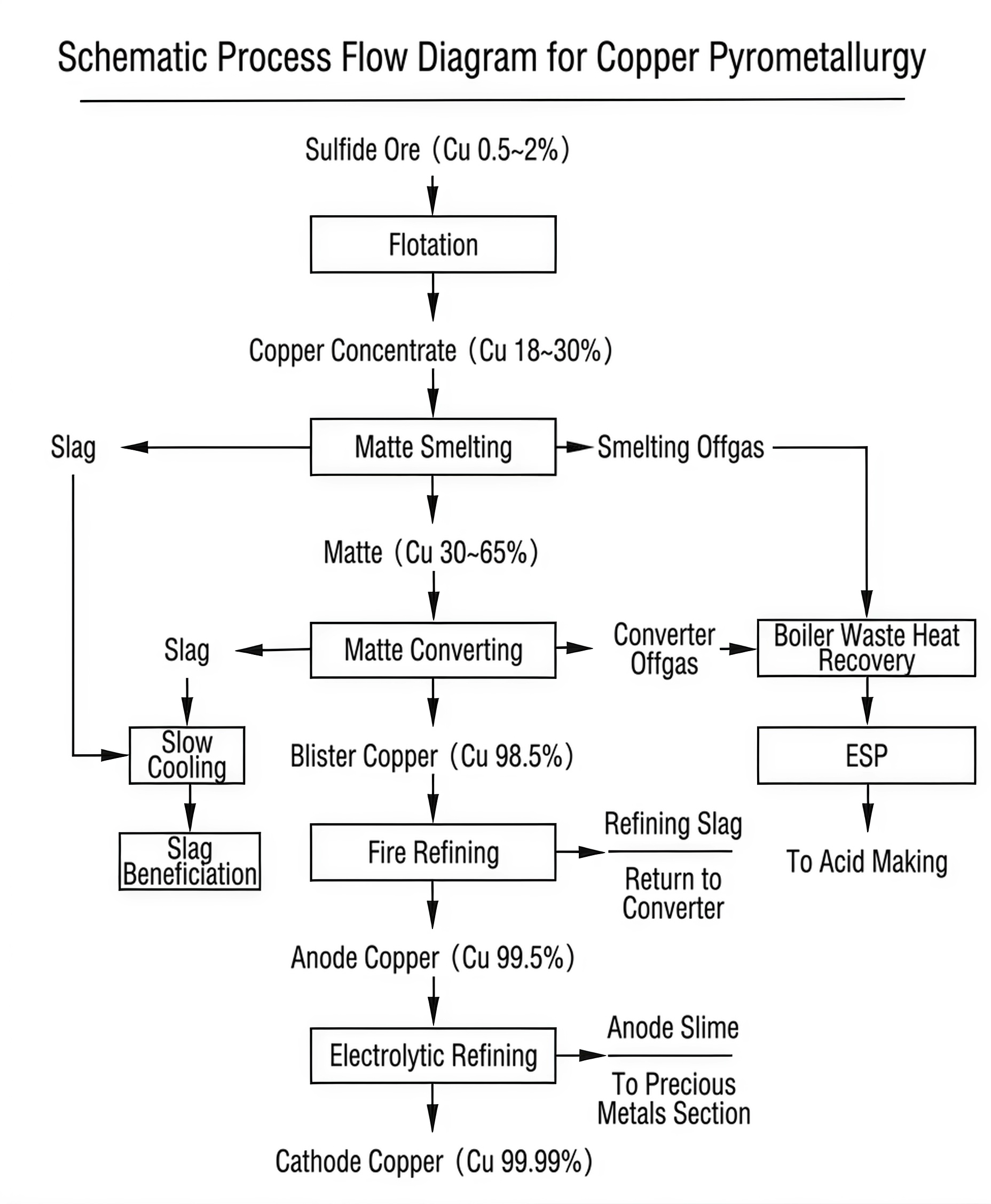
(1) Mat Smelting: Copper concentrate undergoes an oxidation reaction at high temperatures to form a mat. Iron in the minerals is preferentially oxidized to form slag, while copper combines with sulfur to form matte (Cu–Fe–S melt), thereby separating the copper from the gangue. The fundamental principle is to ensure that as much copper as possible enters the matte, while the gangue (useless minerals in the ore) and some impurities are incorporated into the slag.Mainstream smelting technologies: flash smelting, Isa/Osmett top-blown smelting, Noranda smelting, bottom-blown smelting, and side-blown smelting. These processes produce high-grade matte and slag; the low-density slag floats to the surface for separation.
(2) Copper Blast Smelting: Air or oxygen-enriched air is blown into the copper matte to oxidize and remove iron and sulfur, yielding crude copper. The process is divided into a slag-forming phase and a copper-forming phase; the resulting crude copper contains 98%–99% copper.
(3) Pyrometallurgical Refining: Impurities are removed from the crude copper through oxidation, and oxygen is removed through reduction in a refining furnace, after which it is cast into copper anode plates.
(4) Electrolytic Refining: Anode plates serve as the anode, and pure copper foil serves as the cathode. Electrolysis is performed in a copper sulfate electrolyte system to produce 99.99% cathode copper.
1.2 Hydrometallurgical Copper Production
Primarily used for low-grade copper ores and oxidized copper ores. Process flow: ore leaching → extraction → electrowinning to directly produce cathode copper. The overall process operates at low temperatures, with virtually no use of high-temperature refractory materials; refractory applications are concentrated in the pyrometallurgical process.
2 Core Industrial Furnaces for Pyrometallurgical Copper Smelting
2.1 Blast Furnace
(1) Flash Smelter: Consists of a reaction tower, a settling tank, and an ascending flue. Copper concentrate and hot air are injected into the reaction tower from the top, where smelting is completed instantaneously; the molten mixture then falls into the settling tank, where the copper matte and slag are separated by sedimentation.Operating temperatures: 1,450–1,600 °C in the reaction tower and 1,200–1,300 °C in the settling tank; flue gas contains high concentrations of SO₂; the furnace is subject to ferrosilicate slag, copper matte infiltration, and melt erosion.
(2) Top-blown smelting furnace (Isaac furnace/Osmett furnace): A vertical cylindrical furnace in which a top-blown oxygen lance is inserted into the melt, vigorously agitating the melt pool. The melt pool temperature ranges from 1,400 to 1,550 °C; the melt is subjected to intense agitation, resulting in severe erosion from scouring and permeation.
(3) Bottom-blown smelting furnace: A horizontal rotary furnace with air blown through bottom nozzles, resulting in intense agitation of the melt pool. This type is widely used in China, such as in the Shuikoushan copper smelting process (oxygen-enriched bottom-blown smelting furnace).
(4) Side-blown smelting furnace: This uses a fixed rectangular melt pool, with oxygen-enriched air blown in from both sides to create strong turbulent agitation; it is one of the representative examples of China’s independently innovated copper smelting technologies.
In addition, a small number of other types of furnaces exist worldwide, such as the sealed blast furnace for copper smelting, the reverberatory furnace, the Nolanda reactor, the Tenient furnace, and the Vanyukov furnace.
2.2 Blast Furnaces (Blowing of Copper Mat)
(1) PS Converter (Horizontal Side-Blown Converter):The most classic and widely used smelting equipment, accounting for approximately 80% of production capacity. It consists of a horizontal cylindrical rotary furnace with air blown in through side nozzles. It operates intermittently, with significant temperature fluctuations (1150–1300 °C), frequent charging, slag tapping, and copper tapping, resulting in severe thermal shock and pronounced penetration and damage caused by copper matte and iron olivine slag. Continuous smelting furnaces are also in use today.
(2) Flash smelting furnace: Connected in series with a flash smelting furnace to form a “dual-flash” system, it continuously completes the core processes—copper concentrate → matte → crude copper—entirely within the flash furnace.
(3) Top-blown smelters, such as the Osmelt and Isa furnaces, use blowing to process copper matte.
(4) Oxygen-enriched bottom-blown smelters, which are primarily a domestic Chinese process and represent the absolute mainstream in the Chinese market.
Globally, certain regions still utilize process furnaces such as the Mitsubishi continuous smelting process and the Noranda smelting furnace.
2.3 Pyrometallurgical Refining Furnaces
Anode furnaces (rotary refining furnaces): These account for over 80% of copper pyrometallurgical refining. They are horizontal rotary furnaces used for the oxidation and reduction of crude copper at temperatures of 1150–1250 °C, with liquid crude copper and oxidized slag as the process media. Other furnace types, such as stationary reverberatory furnaces and tilting refining furnaces, are found in recycled copper processing facilities.
2.4 Auxiliary Furnaces and Waste Heat Recovery Equipment
Components such as the rising flue of the smelting furnace, waste heat boilers, precipitation and leaching furnaces, slag leaching electric furnaces, copper ladles, and crude copper ladles are responsible for flue gas extraction, slag treatment, and molten metal transfer.
3 Major Refractory Materials and Characteristics of Copper Smelting Furnaces
The primary mechanisms of damage to copper smelting furnaces include: penetration of molten slag and copper matte through brick joints and pores; chemical erosion by iron olivine slag and calcium-iron-silicon slag; thermal shock spalling caused by severe temperature fluctuations; high-speed erosion by molten metal; and corrosion by SO₂ flue gas and alkali metal vapors.Copper-sulfide compounds are extremely corrosive to acidic refractories, and aluminosilicate materials are susceptible to sulfide penetration; therefore, magnesium-based and magnesium-chromium-based refractories are primarily used in the high-temperature zones of copper smelting furnaces.
3.1 Magnesium-Chromium Refractories (Core Lining Materials for Copper Smelting)
This category includes direct-bonded magnesium-chromium bricks, electrically fused re-bonded magnesium-chromium bricks, and semi-re-bonded magnesium-chromium bricks, which serve as critical linings for flash furnace reaction towers, settling tanks, top-blown furnaces, and PS converters.
Main Components: MgO, Cr₂O₃;
Properties: Strong resistance to erosion by iron-olivine-type copper smelting slag and to penetration by copper-sulfide compounds; high strength at elevated temperatures; good thermal shock resistance; Disadvantages: Chromium poses a risk of forming hexavalent chromium under high-temperature redox fluctuations; not suitable for long-term exposure to high-silica acidic slag.
Applications: Reaction towers of flash furnaces, melt pool areas of settling tanks, melt pools of Isa furnaces, and linings of PS converters.
3.2 Magnesium-Aluminum Spinel Bricks (Chromium-Free Alternative Material)
The main phase is magnesium-aluminum spinel (MgO·Al₂O₃).
Properties: Chromium-free; resistant to alkaline slag erosion; excellent thermal shock resistance; resistance to copper-rich and iron-olivine slag erosion is weaker than that of magnesium-chromium bricks; suitable for areas with low to moderate erosion.
Applications: Anode furnaces, upper sections of converters, flue ducts, slag depletion furnaces, and similar locations.
3.3 Magnesia Bricks (Periclase Bricks)
High-purity magnesia bricks, MgO ≥ 95%.
Properties: High-temperature resistance and resistance to alkaline slag; moderate thermal shock resistance; limited resistance to copper smelting slag with high FeO content; susceptible to FeO erosion. Primarily used in refining anode furnaces.
3.4 Aluminum-Silicon Refractories (High-Alumina Bricks, Clay Bricks)
High-alumina bricks and clay-based refractory bricks.
Properties: Low cost, good thermal shock resistance; poor resistance to erosion by copper sulfide and iron olivine slag; highly susceptible to penetration by molten material; cannot come into direct contact with matte or molten slag.
Applications: Used exclusively for insulation layers in flue ducts, waste heat boilers, and the outer layers of kilns; not suitable for use as a working lining.
3.5 Unshaped Refractories (Castables, Rammed Refractories)
Magnesium-chromium castables, magnesium spinel castables, and high-alumina castables.
Characteristics: Good structural integrity, suitable for complex structures and repair work; electrofused aggregate magnesium-chromium castables are used for wear-prone areas such as furnace mouths, air inlets, and burners in smelting furnaces; high-alumina castables are used for flue insulation.
3.6 Insulating Refractories (Lightweight Bricks, Ceramic Fibers, Calcium Silicate Boards)
Lightweight high-alumina bricks, alumina-silica fiber products, and calcium silicate insulation boards.
Characteristics: Low thermal conductivity; used as insulation layers in furnace linings to reduce shell temperatures and minimize heat loss; direct contact with copper alloys or molten slag is strictly prohibited; to be used solely as thermal insulation layers.