
Yongyi Refractory × Gansu Hengya: Overcoming Co-processing Erosion Challenges to Boost Green Efficiency in Northwest Cement
Client: Gansu Hengya Cement
Industry: Cement Manufacturing (Large-scale Clinker Production & Co-processing)
Services Provided: Supply of Anti-Crusting and Anti-Erosion Specialty Refractories & Refined Furnace Construction
Project Background: Gansu Hengya is a vital backbone cement enterprise in Northwest China. Responding actively to the national call for green building materials, the company has integrated industrial and municipal solid waste co-processing technologies into its clinker production lines. However, the heavy use of alternative fuels fundamentally altered the traditional thermal and chemical environment within the rotary kiln, posing unprecedented challenges to the existing furnace lining. To ensure the long-term stable operation of the production line under these complex conditions, Gansu Hengya conducted a rigorous selection process for refractory suppliers. Yongyi stood out due to our extensive experience in combating severe kiln erosion.
Project Challenges: During the co-processing of solid waste, large volumes of highly concentrated, harmful volatile gases—such as alkalis, chlorine, and sulfur—are generated inside the kiln. These gases easily condense on the inner walls of the transition zone, preheater, and calciner, causing severe “alkali-sulfur erosion,” structural spalling, and frequent crusting and blockages of the refractory materials. This not only drastically shortens the lifespan of the refractory bricks but also severely impairs system ventilation and clinker output. The client urgently required a comprehensive refractory solution that could deliver both “powerful anti-erosion” and “excellent anti-crusting” performance.
Yongyi’s Solution:
Pemium Product Supply (Targeted Anti-Erosion and Anti-Crusting Configuration): Addressing the unique demands of Gansu Hengya’s co-processing environment, Yongyi’s technical team implemented a targeted material configuration strategy. For the upper and lower transition zones, which suffer the most severe alkali-sulfur erosion, we selected premium Silica-Mullite Bricks (Silicon Carbide Composite Wear-resistant Bricks) featuring extremely low porosity and outstanding chemical erosion resistance. Their unique dense structure effectively blocked the penetration of harmful gases and significantly reduced crust adherence. In the core burning zone, we deployed highly stable magnesia-iron-alumina spinel bricks to ensure rapid and robust kiln crust formation even under complex fuel conditions. Furthermore, high-strength anti-crusting castables were extensively applied throughout the preheating system.
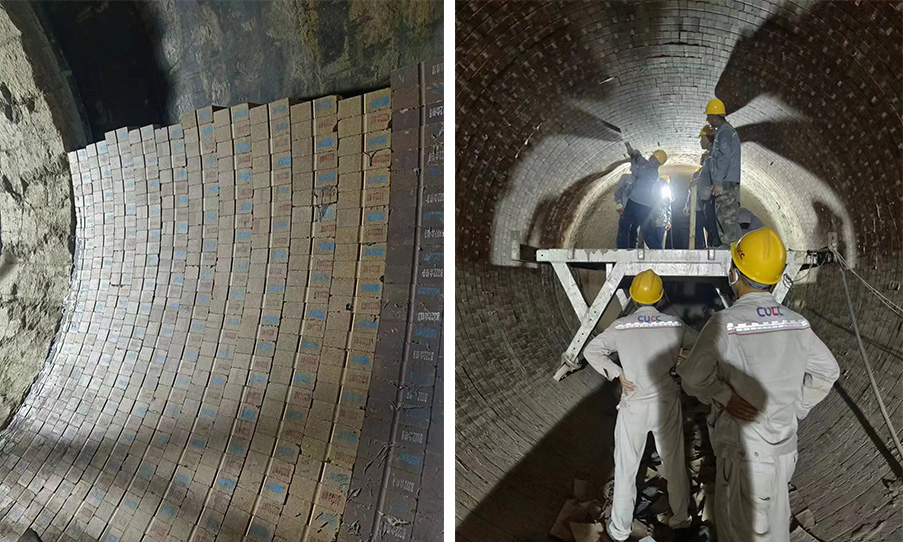
Professional Construction Services (Strict Expansion Joint Control and High-Strength Anchoring): “30% materials, 70% construction.” Considering the large temperature variations in Northwest China and the severe thermal stress fluctuations of refractories under complex working conditions, Yongyi’s construction team executed extremely precise calculations and control over “expansion joint” allowances during masonry. During the casting construction in irregular sections like the calciner and preheater, we utilized high-quality heat-resistant steel anchors and strictly adhered to refined vibration and baking protocols. This ensured the overall strength and anti-spalling performance of the lining structure.
Customer Value & Results: Following the implementation of Yongyi’s customized anti-erosion refractory solution, Gansu Hengya’s cement production line completely resolved the issues of frequent crusting and red-kiln shutdowns, even while increasing the proportion of solid waste co-processing. The kiln system now enjoys smooth ventilation and highly stable thermal conditions. The refractories in the transition zone have demonstrated astonishing lifespans against spalling and erosion, drastically reducing the refractory consumption cost per ton of clinker. Yongyi’s premium products and services have provided the most solid furnace guarantee for Gansu Hengya’s green, low-carbon, and highly efficient production.