
Yongyi Refractory × Shandan Tieqi: Breaking Through with Low Thermal Conductivity Technology to Build an Energy-Saving Cement Demonstration Line in a Frigid Region
Client: Shandan Tieqi Cement
Industry: Cement Manufacturing (Dry Process Cement Clinker Production Line)
Services Provided: Supply of Low Thermal Conductivity Energy-Saving Refractory Materials and Strict-Standard Refined Furnace Construction Services
Project Background: Shandan Tieqi Cement is a key building materials enterprise in the Hexi Corridor of Gansu Province. Located in a frigid northwestern region with long, extremely cold winters, the rotary kiln shell dissipates heat to the outside much faster than kilns in inland plains, leading to persistently high coal consumption. Driven by the industry’s overarching trend of “energy conservation and carbon reduction,” Shandan Tieqi urgently sought to drastically lower the kiln shell surface temperature and minimize heat loss by upgrading their refractory lining system during this major overhaul. Yongyi successfully secured the project by leveraging our innovative achievements in low thermal conductivity refractories and our extensive construction experience in frigid northwestern climates.
Project Challenges: Traditional single-layer refractory bricks have a relatively high thermal conductivity. If an insulation layer is simply added inside the kiln purely for heat retention, it is highly prone to structural fracture, “red kiln” incidents, or brick collapse during the dynamic rotation of the kiln. The challenge for the client was: How to achieve ultimate thermal insulation and energy savings in the rotary kiln (especially the transition zone) without sacrificing the refractory material’s resistance to mechanical stress, chemical erosion, and abrasion? Furthermore, the frigid climate posed a severe test for mortar mixing and castable curing during on-site winter construction.
Yongyi’s Solution:
Premium Product Supply (Multi-Layer Composite Low Thermal Conductivity Technology): Breaking away from traditional thinking, Yongyi’s technical team introduced the new-generation composite structure low thermal conductivity bricks (e.g., Low Thermal Conductivity Silica-Mullite Composite Bricks) to Shandan Tieqi. This product utilizes a high-strength, wear-resistant, and erosion-resistant silica-mullite material for the working layer, while innovatively incorporating a high-strength, lightweight insulating material on the non-working layer (the side facing the kiln shell). This integrated molded structure ensures robust performance on the working face while essentially putting a “thermal down jacket” on the rotary kiln. For the burning zone, we matched this with premium magnesia-alumina spinel bricks, known for their exceptional coating adherence and thermal shock stability, comprehensively guaranteeing system longevity and energy efficiency.
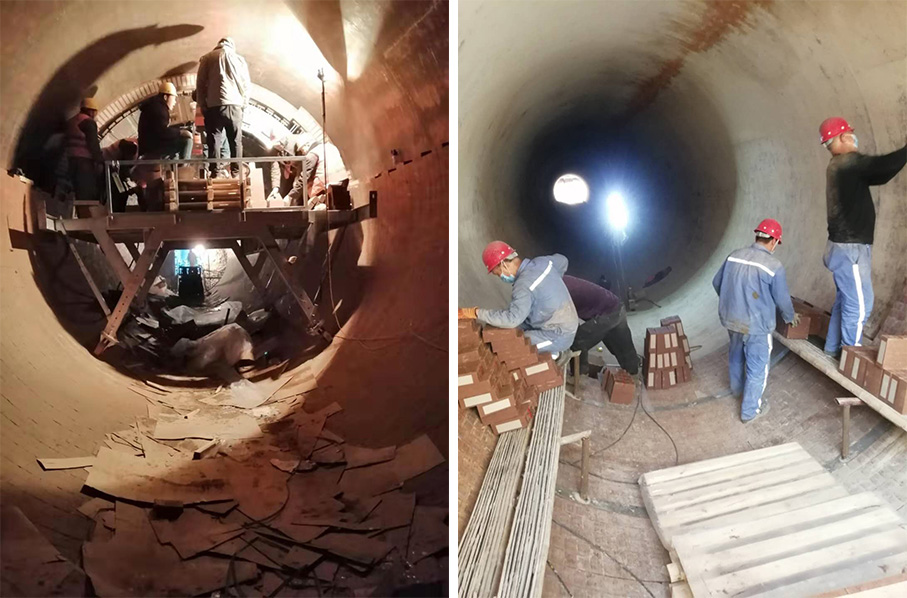
Professional Construction Services (Frigid Climate Operations and Precise Circumferential Alignment): “30% materials, 70% construction.” The masonry of composite bricks requires incredibly strict control of brick joints. Yongyi dispatched a senior furnace masonry team to execute the highest-level “micro-joint masonry” process on-site, ensuring seamless connection between the composite insulation layers and blocking thermal bridging effects. To counter the frigid climate, the construction team implemented strict winter construction safeguard measures, including erecting insulation tents and mixing mortar/castables with warm water. This ensured excellent bonding strength for the fire mud and castables under low temperatures, laying a solid foundation for subsequent safe operations.
Customer Value & Results: Following the technical upgrade and resumption of production at the Shandan Tieqi rotary kiln, the energy-saving results were immediate. Infrared temperature measurement data showed that the surface temperature of the transition zone shell, where Yongyi’s low thermal conductivity refractories were applied, dropped by an average of 30°C to 50°C compared to previous campaigns. This massive reduction in heat loss translated directly into a significant decrease in coal consumption, saving the enterprise hundreds of tons of standard coal annually, drastically lowering production costs, and reducing carbon emissions. Yongyi’s solution not only effectively extended the kiln’s lifespan but also helped Shandan Tieqi become a true benchmark for green and energy-saving operations in the region.